
The care sector is in disarray. There’s no other way to put it. While our vision statement emphasises improving the quality of life as the standard outcome of care, it is crucial to establish practical ethical guidelines and care standards for any civilised country or community.
The United Nations Declaration of Human Rights is at the foundation of this, which discusses outcomes but not the actions or guiding principles needed to achieve them. Although there is the NDIS Code of Conduct, it still fails to adequately encompass our entire community and truly integrate into an inclusive framework.
Below are international principles of business ethics that apply to every individual who steps foot in our community, whether they are residents or not. These are our expectations and serve as a solid ethical foundation for everyone, no matter their beliefs. They are designed to be universal and inclusive.
We are a registered provider, which is significant as it demonstrates our commitment from the beginning to respect our work and strive for excellence. Unfortunately, less than 5% of providers are registered as of now. Being registered does not guarantee standards; it merely indicates that the proper paperwork exists.
We aim to meet the UN Sustainability Goals and aspire to new standards, such as ISO standards, which focus on staff quality, qualifications, and care models beyond just having the necessary paperwork. This is something we aim to develop in the mid-term future. In the meantime, I will add the UN Sustainability Goals and the international social sustainability principles, as sustaining our social care model is critical for our community’s continuity.
While this will be an ongoing discussion in the future, with the collaboration of our community, its members, and staff, this is a reasonable point to draw a line in the sand. I am unsure if regulation will produce workable standards with measurable outcomes; I suspect we will continue to measure irrelevant parameters without real progress. However, as we pave the way forward, we can consider how to establish meaningful standards. ISO standards have existed for many years, and perhaps we can find our path to develop and measure ourselves beyond just having the proper forms that lack substance. It is my intention, with your collaboration, to lead the way in this effort.
The 12 Principles of Business Ethics
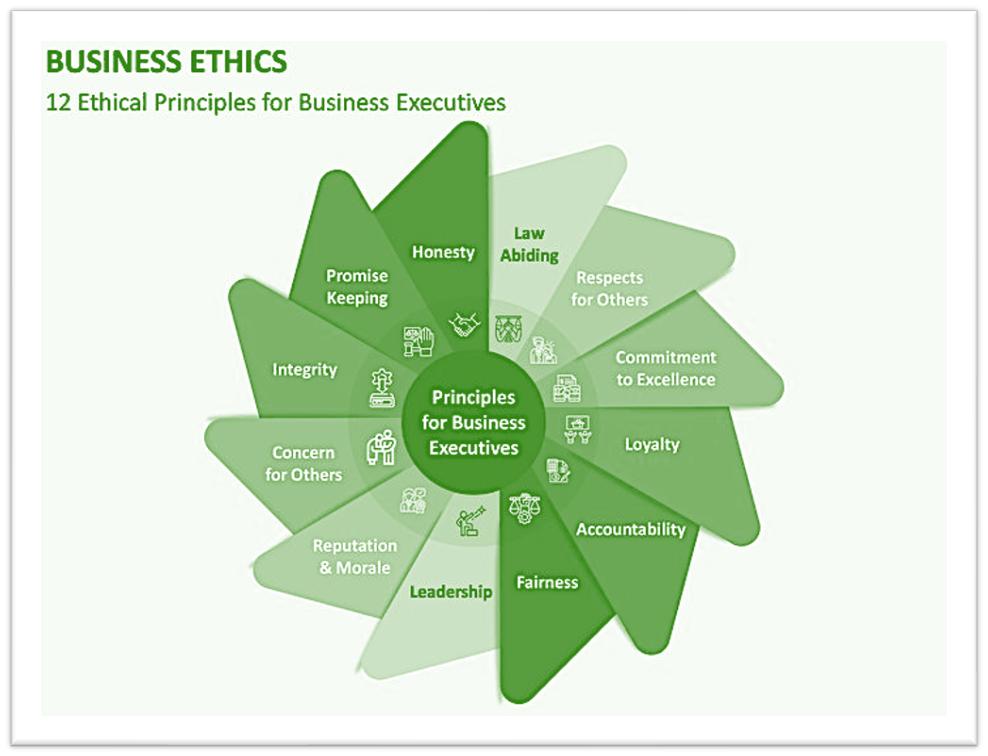
- HONESTY
All personnel must be committed to telling the truth in all communication and actions. This includes never purposely telling partial truths, selectively omitting information, or making misrepresentations or overstatements. Honesty also means reliably sharing both good and bad news with equal candour. - FAIRNESS
All dealings and relationships must be founded on a conscious commitment to fairness, treating others as you would like to be treated. Fairness requires treating all individuals equally and courteously, never exercising power arbitrarily, and never exploiting weaknesses or mistakes for personal or corporate benefit. - LEADERSHIP
Leadership is a commitment to excellence through ethical decision-making, demonstrated by a conscious effort to set a positive example of moral behaviour. Businesses and executives maintain their leads by constantly improving operational efficiency, worker satisfaction, and customer approval. - INTEGRITY
Organisations and personnel demonstrate integrity through consistent actions and words that inspire trust and credibility. Integrity also means keeping promises, honouring commitments, meeting deadlines, and refusing to participate in unscrupulous activities or business dealings. - COMPASSION
Fostering an environment of empathy and compassion requires kindness and caring toward all personnel, business partners, and customers. Business goals must be benevolent, which is ensured by spending enough time understanding the needs and sensitivities of others, including the local community. - RESPECT
A full commitment to all personnel’s human rights, dignity, autonomy, interests, and privacy demonstrates respect. It means recognising that everyone deserves equal respect and support for sharing ideas and opinions without fear of any penalty or termination. - RESPONSIBILITY
Employees exhibit responsibility by taking full ownership of their jobs and striving to be conscious of their operational, financial, and business consequences. Taking responsibilities seriously also demonstrates employee maturity and ability to perform without strict supervision. - LOYALTY
Loyalty is proven by never disclosing information learned in confidence and remaining faithful to coworkers, clients, business partners, and suppliers. Loyal employees avoid conflicts of interest, help build and protect their company’s good reputation, and boost their coworkers’ morale. - LAW-ABIDING
Organisations must comply with all applicable laws and codes from local, state, and federal agencies. Law-abiding businesses and personnel also adhere to industry and trade regulations, marketplace standards, and any additional mandatory organisational policies, practices, and procedures. - ACCOUNTABILITY
Accountability requires a total commitment to the ethical quality of all decisions, actions, and relationships. High expectations for ethical behaviour drive business practices when an organisation and its personnel are held accountable to fellow employees, consumers, the local community, and the broader public. - TRANSPARENCY
Committing to transparency requires making business information and policies available to appropriate groups, such as investors, personnel, and consumers. This includes sharing criteria for price hikes, wages, hiring, promotions, workplace infringements, and terminations. - ENVIRONMENTAL CONSCIOUSNESS
Organisations and personnel demonstrate a commitment to the environment by helping mitigate the effects of global climate change. Beneficial actions include reducing the negative environmental impact of doing business by improving energy efficiency, lowering carbon emissions, reducing water usage, and minimising waste.
The United Nations Guidelines for Meeting the Sustainability Goals
There are many methods of implementing sustainable development goals, one of which is ISO 2600. This method is a guideline—not a certification—but it enables businesses to make their vision of being sustainable a reality. Given the world climate, this is the best way forward for sustainability, business, and social continuity.
There are seven key areas of social responsibility:
- Accountability
- Ethical behaviour
- Transparency
- Respect for human rights
- Respect for stakeholder interests
- Respect for the rule of law
- Respect for international norms of behaviour
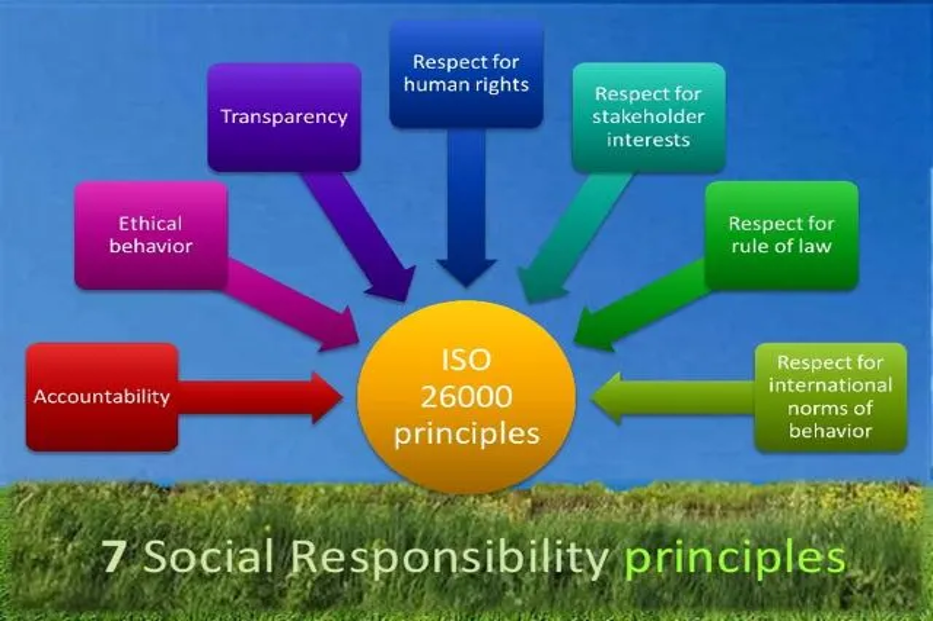
Principles of Social Responsibility
This clause guides seven principles of social responsibility.
When approaching and practising social responsibility, the overarching objective for an organisation is to maximise its contribution to sustainable development. Within this objective, although there is no definitive list of principles for social responsibility, organisations should respect the seven principles outlined below and the principles specific to each core subject.
Organisations should base their behaviour on standards, guidelines or rules of conduct that are accepted principles of proper or good conduct in specific situations, even when these situations are challenging. In applying this International Standard, an organisation should consider societal, environmental, legal, cultural, political and organisational diversity, as well as differences in economic conditions, while being consistent with international norms of behaviour.
Accountability
An organisation should be accountable for its impacts on society, the economy and the environment. This principle suggests that an organisation should accept appropriate scrutiny and accept a duty to respond to this scrutiny. Accountability involves an obligation on management to be answerable to the controlling interests of the organisation and on the organisation to be accountable to legal authorities about laws and regulations.
Accountability for the overall impact of its decisions and activities on society and the environment also implies that the organisation’s answerability to those affected by its decisions and activities and society generally varies according to the nature of the impact and the circumstances. Being accountable will have a positive effect on both the organisation and society. The degree of accountability may vary but should always correspond to the amount or extent of authority.
Those organisations with ultimate authority are likely to take greater care of the quality of their decisions and oversight. Accountability also encompasses accepting responsibility where wrongdoing has occurred, taking the appropriate measures to remedy it, and taking action to prevent it from being repeated. An organisation should account for the impacts of its decisions and activities on society, the environment and the economy, especially significant negative consequences, and the actions taken to prevent repetition of unintended and unforeseen negative impacts.
Transparency
The principle is that an organisation should be transparent in its decisions and activities’ impact on society and the environment. An organisation should disclose in a clear, accurate and complete manner, and to a reasonable and sufficient degree, the policies, decisions and activities for which it is responsible, including their known and likely effects.
This information should be readily available, directly accessible and understandable to those who have been or may be, affected in significant ways by the organisation. It should be timely, factual, and presented clearly and objectively to enable stakeholders to accurately assess the impact of the organisation’s decisions and activities on their respective interests.
The principle of transparency does not require that proprietary information be made public. It does not involve providing privileged information that would breach legal, commercial, security or personal privacy obligations.
Principles of Social Responsibility
This section outlines seven guiding principles of social responsibility. When practicing social responsibility, the overarching objective for any organisation is to maximise its contribution to sustainable development. Organisations should respect these principles, regardless of the situation, even when facing challenges. In doing so, organisations must consider social, environmental, legal, cultural, political, and organisational diversity, as well as economic differences, while maintaining consistency with international norms of behaviour.
Accountability
Organisations must be accountable for their impact on society, the economy, and the environment. This includes accepting appropriate scrutiny, being answerable for decisions and activities, and taking responsibility for negative impacts by preventing their recurrence. Accountability ensures that those with decision-making authority act responsibly and remedy any wrongdoing.
Transparency
Organisations should be transparent about the impacts of their decisions and activities. Transparency involves sharing relevant information with stakeholders in a clear, accurate, and timely manner, without breaching legal or privacy obligations. Information on decision-making processes, performance, and stakeholder engagement should be accessible to those affected.
Ethical Behaviour
Ethical behaviour requires organisations to act with honesty, fairness, and integrity, showing concern for people, animals, and the environment. Organisations should promote ethical standards, encourage ethical conduct, address conflicts of interest, and ensure oversight mechanisms are in place to support ethical behaviour throughout their operations.
Respect for Stakeholder Interests
Organisations should recognise and consider the interests of all stakeholders, not just owners or clients. This involves identifying stakeholders, responding to their concerns, assessing their influence, and considering societal expectations related to sustainable development. The views of affected stakeholders must be valued, even if they lack formal roles within the organisation.
Respect for the Rule of Law
Respecting the rule of law is essential. Organisations must comply with all legal obligations and ensure that their activities adhere to the applicable legal framework. This requires ongoing awareness, compliance, and regular review of legal obligations in every jurisdiction in which the organisation operates.
Respect for International Norms of Behaviour
Organisations should respect international norms of behaviour, particularly when local laws fall short. In such cases, organisations should align with these norms as closely as possible, avoid complicity in wrongful acts, and, when feasible, work towards improving legal protections within the jurisdiction.
Respect for Human Rights
Organisations must uphold and promote human rights, respecting their universality across all countries and cultures. In situations where human rights are inadequately protected, organisations should still adhere to international standards, avoiding exploitation and harm while promoting respect for human dignity.
The NDIS Code of Conduct
The NDIS Code of Conduct requires workers, key personnel, and providers delivering NDIS supports and services to uphold the following standards while providing those supports and services:
- Act with respect for individual rights: This includes respecting freedom of expression, self-determination, and decision-making, in accordance with applicable laws and conventions.
- Respect privacy: All people with disability have the right to privacy, which must be respected at all times.
- Provide safe and competent supports: Services must be delivered safely, competently, and with care and skill.
- Act with integrity, honesty, and transparency: Every action and decision must reflect these values.
- Promptly address concerns: Take timely action on matters that may impact the quality and safety of supports and services provided to people with disability.
- Prevent and respond to violence, exploitation, neglect, and abuse: Take all reasonable steps to protect people with disability from harm.
- Prevent and respond to sexual misconduct: Ensure safety by taking appropriate action to prevent and address any form of sexual misconduct.
- Ensure fair pricing: Providers must not engage in unfair pricing when supplying or promoting goods and services for NDIS participants.
By adhering to these principles, the NDIS Code of Conduct ensures that individuals with disability receive the dignity, respect, and quality of care they deserve, fostering a community where everyone can live safely, freely, and with autonomy.